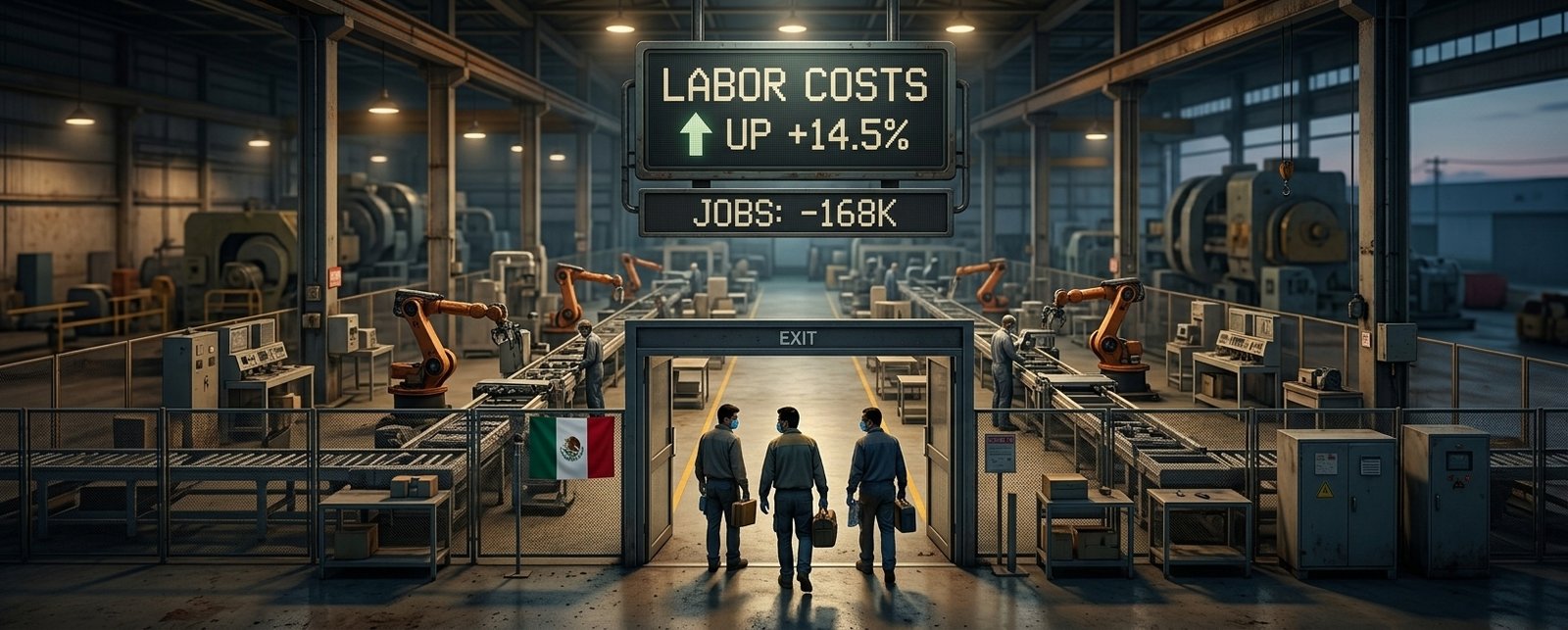
August 26, 2026. The manufacturing industry in Mexico lost 168,616 jobs during the first half of 2026, in a context where the sector faces higher labor costs and economists warn about the limits of sustaining double-digit increases to the minimum wage, a warning signal for companies dependent on labor-intensive operations.
According to data from the National Occupation and Employment Survey (ENOE) of Inegi, the employed population in manufacturing went from 9.476 million people at the close of 2025 to 9.307 million at the end of June 2026.
The reduction in manufacturing employment occurs in a sector that once represented nearly a fifth of the country's employed population and that over recent years has registered significant personnel cuts, directly affecting the value chain of suppliers, transporters, and industrial services.
Minimum wage and pressure on business costs
The behavior of manufacturing employment coincides with a period of double-digit increases to the minimum wage, a policy that the Government of Mexico has maintained since the administration of former President Andrés Manuel López Obrador.
During this period, increases to the minimum wage have been above general annual inflation, while for 2027 a new adjustment of 12% is shaping up. Economists warn that maintaining increases of this magnitude can raise pressures on labor costs and eventually reduce incentives for formal hiring.
Salaries rise while employment falls
Since the beginning of Claudia Sheinbaum's administration, real average remunerations per employed person in the manufacturing sector have registered an average annual growth of 4.3%, according to Inegi figures.
In that same period, employed personnel in the manufacturing industry registered contractions in 12 of the last 21 months considered. The largest monthly loss of manufacturing employment so far in the current administration was recorded in September 2025, with a contraction of 498,553 workers.
"As the cost of labor increases, the attractiveness of hiring workers is reduced and the use of machines is preferred. The more benefits cost, the fewer companies will offer them"
This was indicated by Carlos López Jones, director of the consultancy Tendencias Económicas y Financieras, who considered that minimum wage increases, added to the cost of labor benefits, raise the hiring cost and can subtract competitiveness from labor against automation.
Cumulative loss of 431,000 jobs in this Presidential term
So far in Claudia Sheinbaum's administration, manufacturing industries have accumulated a loss of 431,251 workers, equivalent to about 5% of the labor force registered at the beginning of the sexennium.
During the elapsed quarters of the current administration, the majority have registered contractions in the number of workers occupied in manufacturing. The largest quarterly drop occurred in the second quarter of 2025, when the manufacturing industry lost 221,453 workers.
The only quarterly period with a positive result was from July to September 2025, when employed personnel in manufacturing increased by 162,872 people.
Economists warn limits to wage model
Economists like Julio Santaella, former president of Inegi, and Abraham Vela Dib, former president of Consar, have warned that minimum wage increases have a limit, given the risk that a higher cost per worker ends up discouraging formal hiring.
Although the evolution of manufacturing employment does not depend solely on the behavior of wages, companies in the sector face an increasingly complex equation: rising labor costs, competition from automation, and a global market that demands efficiency.
For executives of manufacturing companies in Mexico, the message is clear: reviewing cost structures, evaluating investments in technology, and anticipating the effects of the upcoming 2027 wage increase will be decisive to maintain competitiveness in an environment where formal employment faces growing pressures.
Author: Redacción Mundo Ejecutivo
Source: https://mundoejecutivocdmx.com/mundo-economico/manufactura-mexico-pierde-empleos-2026/