Mexico's Power Grid in 2026: What Nearshoring Manufacturers Need to Know
|
Mexico's manufacturing boom has a bottleneck, and it isn't labor, logistics, or land — it's electricity. As nearshoring investment continues to flow into the Bajío, Nuevo León, Chihuahua, and Baja California, the national grid is falling further behind the demand it's being asked to serve. For manufacturers evaluating or expanding a Mexican footprint, power availability has become a site-selection issue on par with any other — and the companies planning around it now are the ones avoiding costly surprises later.
THE CAPACITY GAP, BY THE NUMBERS
|
The strain on Mexico's grid is no longer anecdotal — it's structural, and the data confirms it:
- Electricity demand has grown 3.4–3.5% a year, while transmission capacity has expanded only about 0.1% a year over the same period.
- More than 60% of the national transmission network is already operating near maximum capacity.
- Grid reserve margins fell to about 3% in 2024 — half the 6% regulatory minimum — with 104 grid emergency events logged that year.
- A May 2026 heat wave pushed demand to 48,000 MW, validating forecasts of a record 54,000 MW peak this summer.
- 91% of industrial facilities in Mexico report having experienced a power supply failure; unplanned outages can cost manufacturers up to $200 million per hour in lost production.
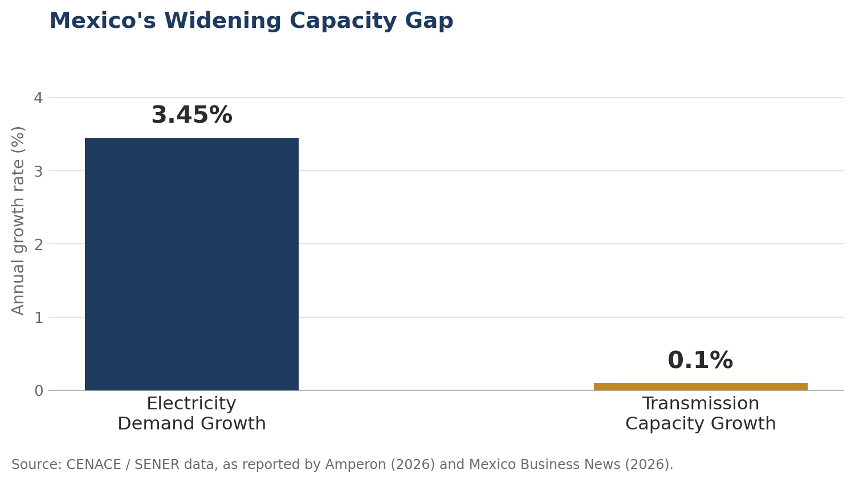 |
| Figure 1. Mexico's electricity demand is growing roughly 35x faster than its transmission network. |
NEARSHORING IS OUTPACING THE GRID THAT FEEDS IT
|
Data centers illustrate the mismatch most starkly: installed capacity reached 279 MW in April 2026 and is projected to hit 1.7 GW by 2031, with Querétaro alone expected to host 69% of that growth. Roughly 540 MW of interconnection requests are currently stuck in the queue. Manufacturing plants face the same reality in slower motion — new capacity requests routinely wait years for CFE interconnection approval, and power availability now shapes land purchase decisions before a shovel goes in the ground.
POLICY IS MOVING, BUT UNEVENLY
|
The federal government isn't ignoring the problem, though its response is mixed:
- CFE's 2024–2030 investment plan commits $23.4 billion, including $7.5 billion for transmission reinforcement, plus a separate $8.2 billion, 58-project transmission expansion (2025–2027) targeting the northern manufacturing corridor.
- The CRE was dissolved and replaced by a new National Energy Commission (CNE); CFE is now required to supply at least 54% of national demand, capping private generation at 46%.
- SENER authorized CENACE to buy emergency power directly from private generators when public capacity falls short — the first formal acknowledgment that CFE alone cannot guarantee reliability.
- Despite these commitments, CFE's 2026 budget was cut 16.7% in real terms versus 2025, and its flagship mixed-generation project awards (LESE) have been delayed three times, with only 56 of 222 submitted proposals meeting technical requirements.
New self-generation rules add another layer manufacturers need to plan around: on-site generation permits are now tied to minimum demand-to-capacity ratios (30% for renewables, 50% for conventional sources), and surplus power sold back to CFE is capped well below market rates. Self-supply systems built without this framework in mind risk non-compliance and permit termination.
THE TAKEAWAY FOR MANUFACTURERS
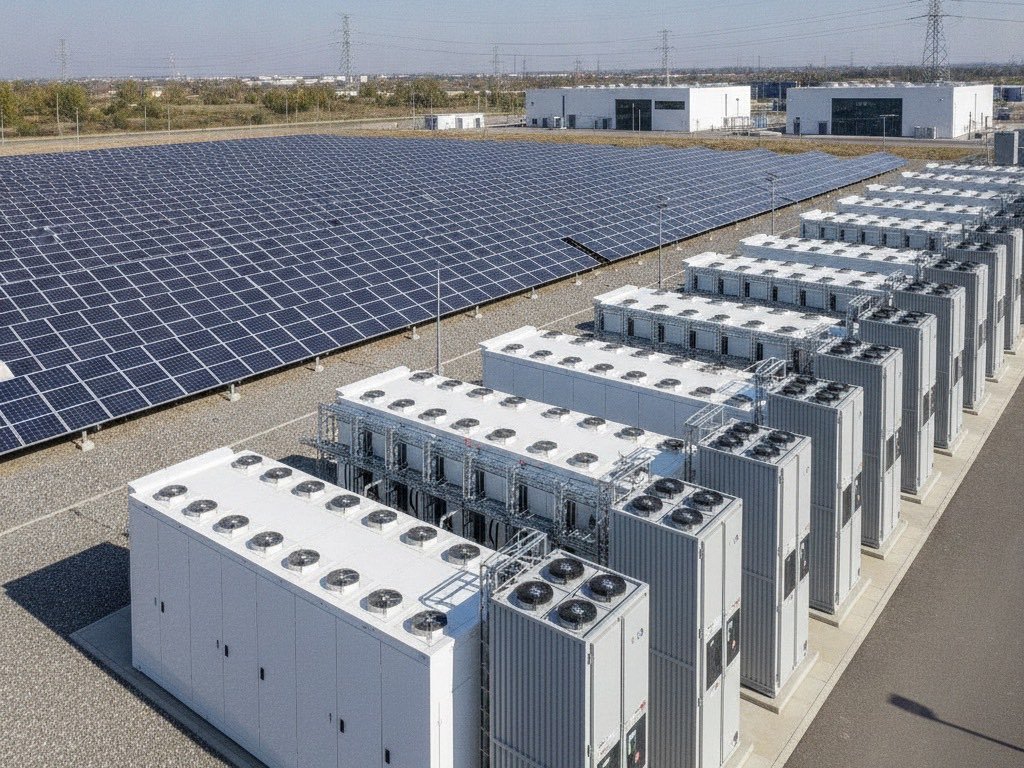
The net effect: manufacturers can no longer treat electricity as infrastructure that simply shows up. A growing number are securing private substations and on-site generation — solar, storage, and backup capacity — before finalizing a site, treating energy self-sufficiency as a prerequisite rather than an afterthought.
|
This is exactly the gap M2 Energy is built to close. We help manufacturers secure available grid capacity (kVA) in constrained regions, and where the grid can't deliver, we design, build, and permit complete behind-the-meter power systems — up to 20 MW, combining generation, solar-plus-storage, and medium/high-voltage infrastructure — under whichever commercial structure fits: turnkey purchase, lease, or PPA. Critically, we manage the full CENACE/CFE/CNE permitting process end-to-end, including compliance with the new self-generation rules outlined above, so clients don't discover a regulatory gap after the system is already built.
If power reliability is a factor in your Mexico operations or expansion plans, now is the time to have that conversation — before it becomes a constraint on the timeline.
| M2 Energy is an independent, manufacturer-agnostic energy consultant and EPC developer serving industrial and manufacturing clients across Mexico, with a U.S. office in Austin, TX. |
| Contact: Monte Mickle, CEO — monte@m2energy.org |
|