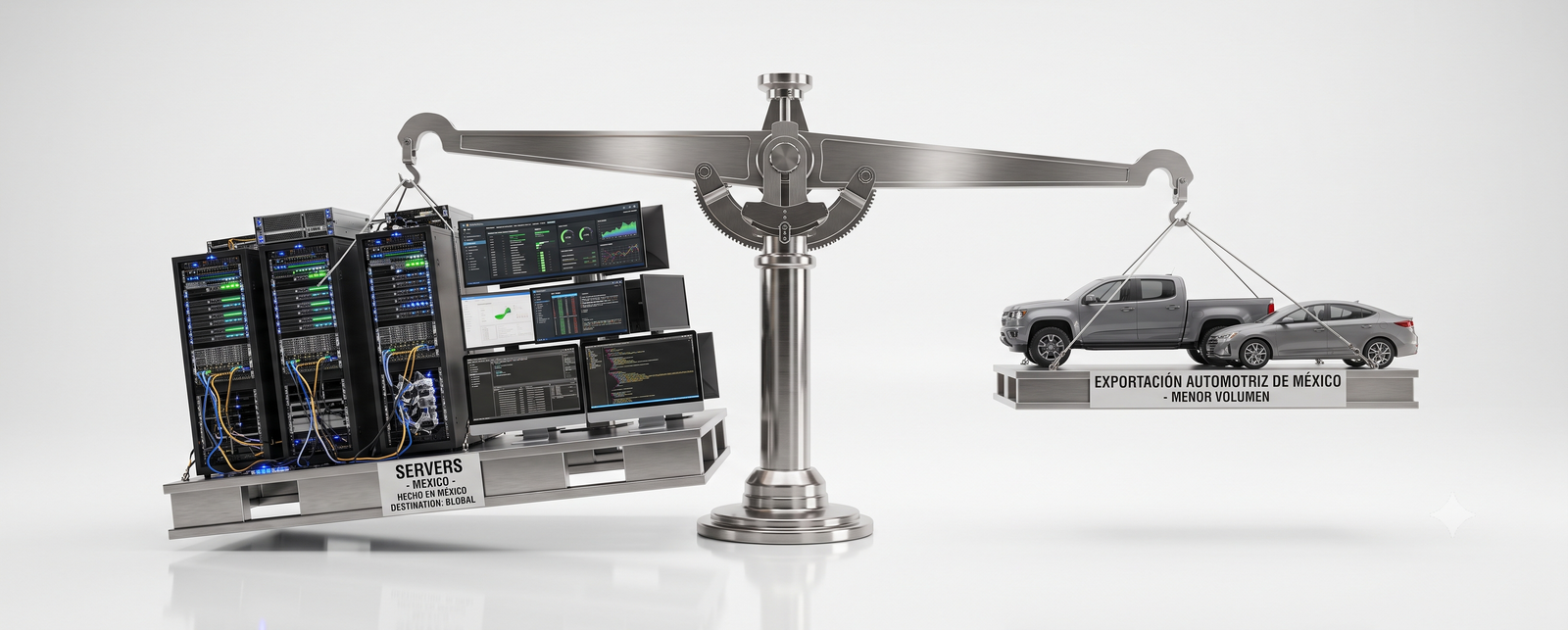
A study by Banco Base reveals that Mexican computer hardware exports grew 144.80% in 2025, surpassing finished vehicles. Driven by United States AI demand, this contract manufacturing expansion presents strategic supply chain vulnerabilities and low domestic value addition for technology stakeholders.
Mexican computer equipment exports surged by 144.80% in 2025 to surpass finished vehicle exports and establish the nation as the primary technology supplier to the US market.
This exponential growth occurred because of accelerating investments in US data centers, which advanced by 29.76% to reach US$102.2 billion in 2025. "Without this sector, total Mexican exports would have fallen 0.54% in 2025, instead of growing 7.64%," says Gabriela Siller, Director of Economic Analysis, Banco Base.
The technological expansion reflects a long-term evolution from the industrial policies of the 1980s. Early public initiatives, supported by leading technology corporations such as IBM and HP, integrated the domestic industry horizontally. This strategy attracted assemblers of equipment and electronic cards utilizing surface mount technology.
These entities laid the groundwork for the electronic contract manufacturers that drive the modern export market. When China entered the World Trade Organization in 2001, manufacturing facilities in Mexico adapted by pivoting toward flexible manufacturing and short-batch production cycles. This agility allowed local operations to manage volatile shifts in northern demand, while Chinese facilities focused on high-volume manufacturing lots.
The contemporary acceleration is highly tied to a favorable tariff differential of more than 30% points over China. This structural trade advantage allowed Mexican operations to displace Asian competitors and secure a dominant position in the US market.
This integration is visible in central processing units and infrastructure equipment designated for hyperscale US data centers to support Generative AI and cloud computing.
Understanding the Whole Picture
According to Select, five major multinational corporations dominate this manufacturing landscape: Foxconn, Flex, Jabil, Sanmina, and Pegatron. These corporations manage large-scale industrial complexes across northern and western states, including Baja California, Jalisco, Chihuahua, and Nuevo Leon.
Despite high export values, according to Banco Base, the computer hardware sector operates under a highly dependent structural model that limits its domestic economic impact.
Import components represent nearly 95% of the total value of these exports, with a vast majority originating from Asian technology hubs, particularly Taiwan. Consequently, the net national value-added component remains minimal compared to the overall cost of imported processors and specialized server memories.
This structural dependency explains why the export surge has not translated into proportional domestic employment growth. The research by Banco Base indicates that employment within the computer manufacturing sector increased by only 9.45% in 2025. This limited growth reflects the highly automated nature of modern technology assembly lines.
Modern facilities rely on advanced robotics and high-precision automation rather than intensive manual assembly lines. A single micro-alignment error or static electricity discharge can ruin components worth thousands of dollars. As a result, contract manufacturers have transformed their human resource requirements over the last few years to seek highly specialized personnel, including engineers for software development, robot programming, digital electronics, and technical English.
To address talent scarcity and mitigate wage inflation, corporations maintain continuous training programs with local technical universities. This presence has become a critical anchor for corporate investments in hubs such as Guadalajara, Chihuahua, Tijuana, and Nuevo Leon, ensuring the geographical permanence of these manufacturing plants.
Furthermore, electronic contract manufacturers have catalyzed the development of specialized local corporations. These local integration companies have expanded their operations to support other industrial sectors, assisting automotive corporations with the design and installation of robotic vehicle assembly lines.
Challenges Remain
Despite positive commercial figures, the industry faces severe structural vulnerabilities and operational capacity thresholds. During 2025, local manufacturing plants operated at a utilization rate between 90.9% and 99.5%. This high rate means that the sector lacks the physical margin required for future output expansion without substantial new capital investments.
External regulatory and macroeconomic factors present additional hazards to the sector. A potential reduction in US data center infrastructure spending would directly lower the demand for the high-end processors that Mexico exports. Operational pressures have already affected the domestic market, as intense US demand has caused shortages of chips and computing equipment for Mexican commercial enterprises.
On the regulatory front, the upcoming formal review of the USMCA poses a significant challenge. The treaty review could introduce stricter rules of origin for computer hardware, given that most electronic inputs originate from non-treaty partners in Asia.
To overcome these limitations and increase national value, industry leaders are promoting a transition toward semiconductor design and programming. This strategy aims to duplicate the successful model of the Intel Design Center in Guadalajara, which employs hundreds of engineers with advanced degrees.
Siller notes that, in the long term, foreign direct investment in this subsector begins to exert a structural effect on export performance, remaining independent of external macroeconomic fluctuations.
https://mexicobusiness.news/cloudanddata/news/mexicos-ai-hardware-exports-overtake-vehicle-shipments

.png)