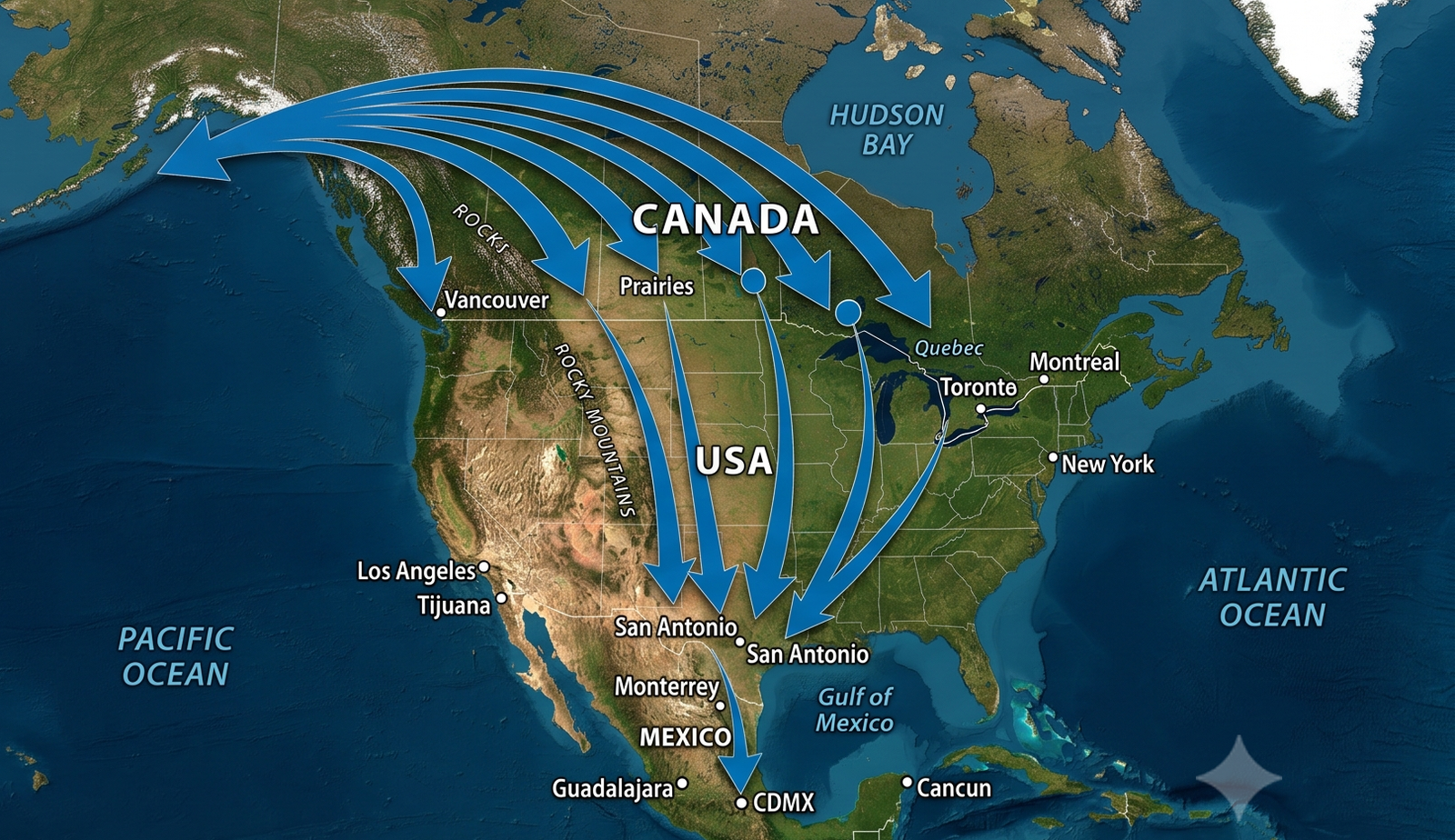
According to Newsweek, the 50% US tariffs on Canadian products are creating incentives for manufacturers to move assembly processes to Mexico; the rules of origin allow goods processed in Mexican territory to avoid this tax.
8/1/2026 · 3:09 PM The United States' trade policy has opened a different scenario than anticipated for part of the manufacturing industry. The 50 percent tariffs announced by the Trump administration against various Canadian products alter the incentives within North American supply chains and position Mexico as an option for manufacturing and assembly processes.
According to Newsweek (International Edition, Vol. 187, No. 3), international trade rules of origin allow the country where a product undergoes substantial transformation to determine its customs origin. Under this criterion, some manufacturers can reorganize part of their production to maintain access to the U.S. market without being subject to the new tariff.
The U.S. measure uses Section 338 of the Tariff Act of 1930, a provision that authorizes the imposition of tariffs of up to 50 percent on goods from countries that discriminate against U.S. products. The Trump administration argues that Canada engages in trade practices that harm U.S. exports.
Trump's tariffs
Mexico maintains USMCA benefits despite new US tariffs: Ramírez Cuéllar
The magazine's analysis explains that the impact of the tariff does not depend on a brand's origin, but rather on where a product undergoes final manufacturing or processing. This criterion alters the route followed by some global production chains.
Rules of origin change the landscape
Newsweek uses the case of hockey sticks to illustrate this effect. Although Canada maintains a strong association with this product, a large part of the professional market uses carbon fiber models whose manufacture occurs primarily in Asia.
"
USMCA
USMCA: Ebrard says 50% tariffs on steel and aluminum are "unsustainable"
The publication points out that brands like Bauer and CCM produce these items outside of Canada, so the goods don't necessarily qualify as Canadian products under US customs regulations. Consequently, the tariff primarily affects manufacturers whose production remains in Canada.
The report summarizes this scenario with a phrase that describes how the supply chain works: "Canada owns the hockey stick in the imagination; China owns it on the factory floor. Trump hit it north, and the supply chain hit it back to Mexico."
Newsweek also notes that customs legislation considers the location where an item undergoes its last substantial transformation, not the country where the brand originated. This principle allows for the reorganization of industrial processes without necessarily changing company ownership.
Mexico emerges as an alternative.
The publication indicates that the new scheme creates incentives to relocate manufacturing processes to Mexico instead of moving plants to the United States. The analysis argues that production costs keep Mexican territory attractive compared to other options within North America.
As an example, Newsweek mentions that Warrior already manufactures part of its production in Mexico. This precedent shows a path that other manufacturers can follow to comply with the rules of origin and maintain access to the U.S. market.
Under this model, components can originate in Asia, undergo manufacturing or assembly processes in Mexico, and then enter the United States as goods whose customs origin corresponds to the territory where that transformation occurred.
The magazine summarizes this potential shift with another conclusion: "The tariff gives Chinese manufacturers no reason to relocate, and it may push them toward Mexico, where Warrior manufactures." The analysis presents this movement as a possible consequence of the current design of trade rules.
Context: Nearshoring and Trade Rules
Nearshoring involves relocating production centers to a country closer to the consumer market. In North America, Mexico is a major player.
A significant part of this process is due to Mexico's geographic location, its logistics network, and the trade framework of the United States-Mexico-Canada Agreement (USMCA).
In recent years, several companies have moved operations from Asia to Mexico to reduce shipping times, lower logistics costs, and bring production closer to the U.S. market. The pandemic, increased maritime costs, and changes in trade policy accelerated this strategy.
Rules of origin are part of this process. Customs authorities determine a product's origin based on the location where substantial transformation occurs, a criterion that defines the application of tariffs and other trade requirements.
In this context, Newsweek's analysis suggests that the new tariffs on Canadian products could alter manufacturing decisions within the region. Under current rules, Mexico appears to be one of the destinations with the greatest potential to receive new production and assembly processes destined for the U.S. market.
VGB. La Silla Rota. https://lasillarota.com/nacion/2026/8/1/aranceles-de-trump-el-efecto-rebote-que-impulsa-las-fabricas-hacia-mexico-newsweek-611050.html

.png)