.png)
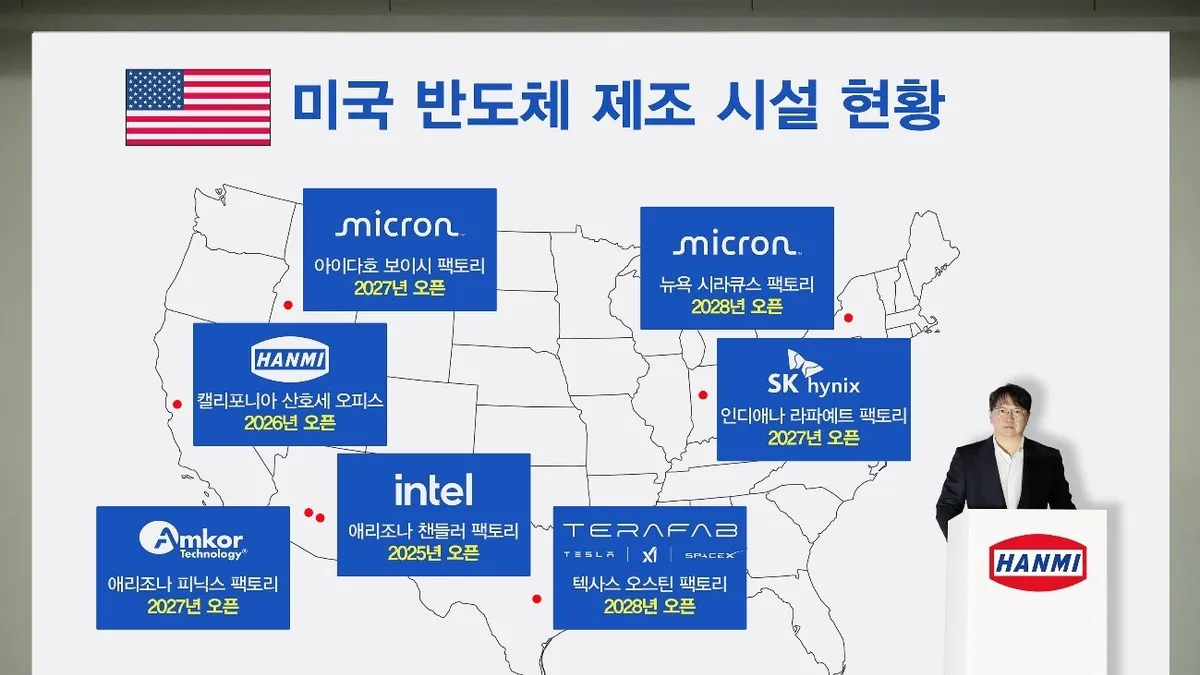
- Hanmi Semiconductor on Monday announced it will formally enter the U.S. market by establishing a local subsidiary, Hanmi USA, in San Jose, California, by the end of 2026.
- Engineers working at the office will offer in-person technical assistance for new fabs being built by global semiconductor firms in the United States, the company said in an emailed statement.
- The U.S. expansion will also facilitate direct collaboration with hyperscalers such as Microsoft, Google, Amazon Web Services and Meta.
The move comes as global demand for semiconductors powering artificial intelligence increases, which in turn is driving investment, Hanmi said.
That includes Intel’s launch of its fifth high-volume fab in Chandler, Arizona, in October 2025. Several other large-scale AI semiconductor production facilities are set to begin production in 2027 and 2028, including Micron in Boise, Idaho; Amkor Technology in Peoria, Arizona; SK hynix in West Lafayette, Indiana; and Elon Musk’s Terafab project.
“As these companies develop proprietary AI chips, they are increasingly involved in reviewing and specifying the core equipment used in manufacturing processes, driving demand for Hanmi packaging solutions,” Hanmi said.
The company also expects that increased use of AI semiconductors will drive demand for its market-dominating thermocompression bonders. Thermocompression bonding is used to bond semiconductors and other devices to substrates or other assemblies.
Hanmi said it plans to release a second-generation hybrid bonder prototype sometime this year. According to Semiconductor Digest, hybrid bonding technology directly bonds copper interconnects between chips and wafers, eliminating bumps created by soldering. This makes for a thinner package, improves heat dissipation and speeds up data transfer.
“As the mass production of [high-bandwidth memory 4] gains momentum this year, we are seeing a concentration of TC Bonder orders in the second quarter, a trend expected to accelerate in the latter half of the year,” said Hanmi Semiconductor Chairman Kwak Dong-shin.
“Through our U.S. subsidiary, we plan to provide proactive, close-range support to meet our customers’ needs,” Kwak said. “As the U.S. emerges as a global semiconductor production hub, we anticipate a steady increase in revenue driven by equipment orders for these new facilities.”
AI-related demand is driving revenue for semiconductor companies around the U.S., as evidenced in recent earnings reports. Teradyne’s Q4 2025 revenue totaled $1.1 billion, up 44% year over year. GlobalFoundries’ Q1 revenue topped $1.6 billion. Applied Materials said it expects 20% growth in its semiconductor business this year. Texas Instruments credited the AI data center boom for much of its reported $4.8 billion in Q1 revenue. And Taiwan Semiconductor Manufacturing Co. reported $35.9 billion in Q1 revenue.