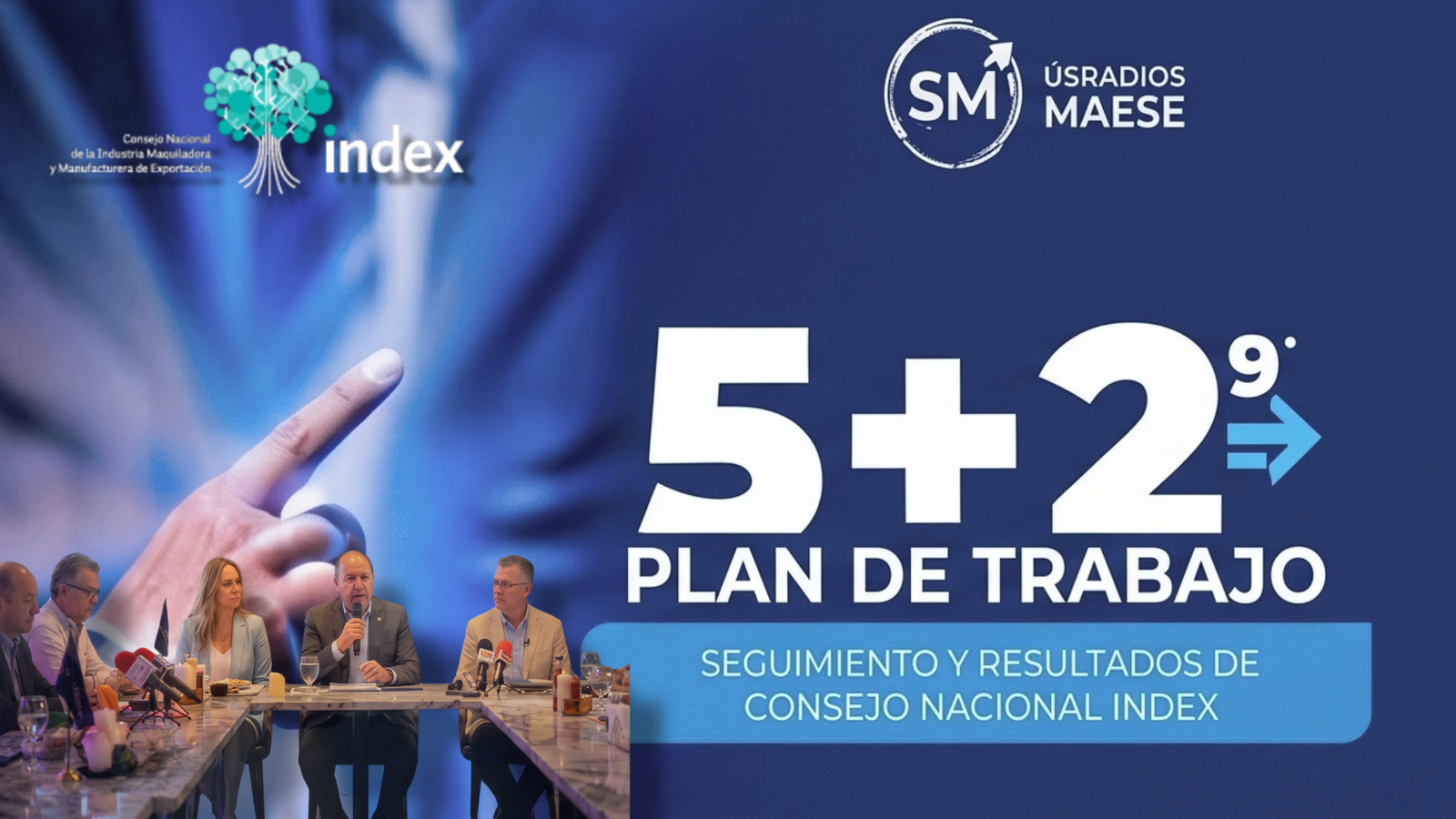
Five regional meetings in September outlined a common agenda: more engineering, more local suppliers, simpler compliance and a stronger national voice for the industry.
Over the last two weeks of September, the leadership race at Index Nacional, the association representing Mexico's maquiladora and export manufacturing industry, took candidate Salvador R. Maese Barraza through Ciudad Juárez, Hermosillo, Nogales, Chihuahua and Monterrey. Across the five stops, he presented a work plan for the 2027–2028 term built around a single question: how can Mexico's export strength translate into more technology, more domestic content and greater certainty for the companies operating under the IMMEX program?
The plan “5 + 2” built on 5 pillars, advanced through two main actions:
5 Pillars
-
Accelerate the transformation to Higher Value-Add, Innovation, and Advanced Technology: Accelerating the technological transition of maquiladoras beyond traditional assembly. The focus centers on engineering design, automation, research and development, intellectual property generation, and high-tech sectors such as semiconductors, medical devices, automotive systems, and advanced electronics.
-
National Supplier Development and North American Integration:
Strengthening tier-2 and tier-3 domestic supply networks to raise national content in export manufacturing, establishing resilient local procurement channels that fully capitalize on USMCA regional value-content rules. -
Competitive Defense of the USMCA and IMMEX Framework:
Providing rigorous technical defense of trade mechanisms and investment protections under the USMCA (T-MEC) review horizon, shielding the IMMEX ecosystem from trade distortions and counterproductive regulatory barriers. -
Infrastructure, Energy, and Regional Logistics:
Expanding logistics corridors, border crossing efficiencies, and industrial infrastructure, while ensuring that manufacturing hubs have reliable access to clean energy and water resources to absorb incoming foreign direct investment (FDI). -
Regulatory Simplification and Consolidated Operating Certainty:
Modernizing administrative frameworks through the consolidation of the IMMEX program, lowering bureaucratic transaction costs, and creating clear, stable legal rules for foreign capital operating in Mexico.
2 Main Actions
Stronger National Representation, giving the industry a more active, technically grounded voice where decisions are made.
Empowered Local Associations, in cities or regions where Index has a regional office, they should be stronger, with more inclusive committees, greater professionalization and better tools to turn its members' needs into solutions.
Maese, who was born in Ciudad Juárez and has spent 34 years in the maquiladora and export manufacturing sector, summarized his leadership approach in four verbs: defend, connect, accelerate and transform.
Regional Industrial Strengths Driving the Modernization
During regional industrial meetings, industry leader Salvador Maese Barraza emphasized that industrial policy must be rooted in regional realities and close collaboration with local manufacturing clusters:
-
Monterrey and Nuevo León: Positioned as a testing ground for modernized trade facilitation and logistics schemes. During the first half of 2026, the state captured $3.712 billion in foreign direct investment and posted $14.166 billion in exports in Q1 alone. Maese highlighted that capital inflows must directly foster domestic suppliers and sophisticated industrial operations.
-
Chihuahua and Ciudad Juárez: With Chihuahua leading Mexican states in exports ($19.015 billion in Q1 2026, representing 13.9% of national exports), Maese stressed that the border’s historical manufacturing legacy must translate into direct decision-making power at the national level and lead the leap into semiconductors and specialized transport electronics.
-
Sonora (Hermosillo and Nogales): Focusing on institutional representation, technical advocacy, and anticipatory policy engagement, Maese underlined the need for professionalized business representation to defend the IMMEX sector’s competitiveness ahead of regulatory changes.
From export volume to technology
In Chihuahua, the argument rested on the numbers. According to the figures presented, the state exported US35.986 billion in the first quarter of 2026, or 22.8% of the highest of any state, and up 69% from a year earlier. Electronics and computing equipment accounted for US26.048 billion of that total, and transport equipment for US3.952billion.The state also received US615 million in foreign direct investment in the first half of the year.
Maese argued that this base should be used to move toward engineering, design, automation, advanced manufacturing and, in particular, semiconductor-related capabilities.
“It is not only about exporting more,” he said. “It is about a growing share of the knowledge, engineering, technology and supply base behind those exports being developed in Mexico.”
That goal is tied to the development of Mexican Tier 2 and Tier 3 suppliers, stronger component traceability and closer links between large manufacturers and domestic firms. The same priorities came up in Ciudad Juárez, alongside obstacles such as energy, water, logistics, border crossings, permits and talent.
Simplification and legal certainty
In Monterrey, the discussion turned to regulation. Nuevo León recorded US14.538billion in exports in the firstquarter,the fourth highest in the country, and attracted US3.712 billion in foreign direct investment in the first half of 2026. Maese proposed studying special trade zones and working with authorities on a more coordinated compliance framework for IMMEX, including the integration of procedures tied to VAT and excise tax certification and a new scheme for Export Manufacturing 4.0.
“Simplification does not mean less compliance,” he said. “It means complying better, with clear processes, reasonable timelines and rules that give certainty to companies that are investing and creating jobs in Mexico.”
He added that competition among regions increasingly depends on legal certainty, traceability, customs digitalization, talent availability and stable rules, not only on cost and location. On the upcoming USMCA review, he said Mexico should use it to strengthen regional integration and raise regional content rather than simply react to possible changes.
Empowering local associations
A recurring theme was how the organization itself should work. In Hermosillo and Nogales, Maese said the national voice of Index should be built from the regions, with stronger local associations, inclusive committees with greater regional participation, and greater professionalization. Proposals include itinerant meetings between the national office and local committees, and a diploma program for executives and managers of business organizations, for which a partnership with Universidad Anáhuac México Norte is being explored. He also outlined governance principles centered on collegial decision-making, transparency and periodic reporting of results.
In Ciudad Juárez, he went further, saying that if elected he would seek direct representation for the city in the organization's National Secretariat.
Next steps
For 2027, the plan calls for regional diagnostics, member priorities, a USMCA strategy and technical lobbying roundtables. For 2028, it focuses on executing and scaling projects in sourcing, digital transformation, infrastructure, talent and preventive compliance.