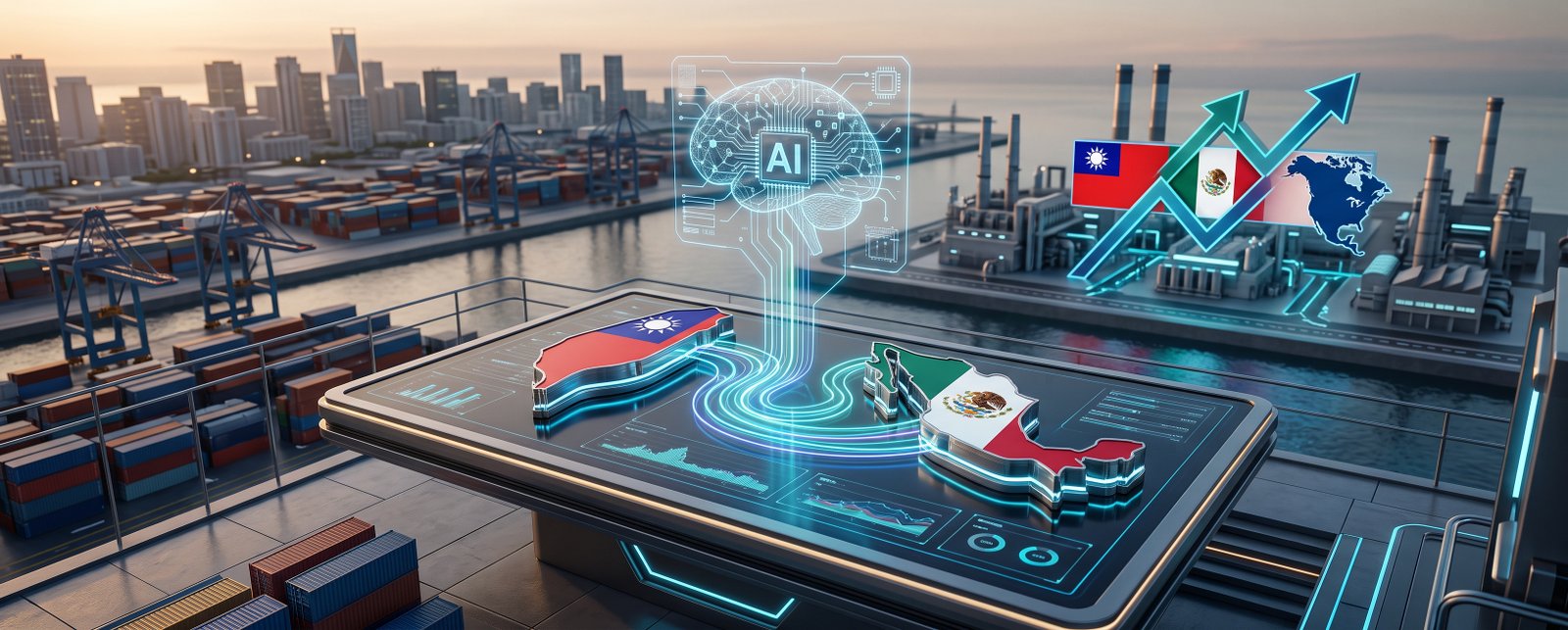
August 18, 2026. Taiwan is expanding trade and investment ties with Mexico as AI infrastructure demand drives growth in semiconductors, servers, computing equipment and electronics manufacturing. With more than 300 Taiwanese companies already operating in Mexico, USMCA access, lower tariffs on Mexican computer equipment entering the United States and near-fully utilized manufacturing capacity could encourage additional Taiwanese investment and strengthen Mexico’s role in North American technology supply chains. Taiwan is strengthening its trade and investment relationship with Mexico as demand for artificial intelligence (AI) infrastructure increases and companies seek production platforms for the North American market. The expansion could position Taiwan as Mexico’s second-largest trading partner if the US-Mexico-Canada Agreement (USMCA) remains in place, according to Violeta Shao-Hui Hsu, Director of the Taipei Economic and Cultural Office in Mexico.
Taiwan ranked as Mexico’s third-largest trading partner in 2025, surpassing the United Kingdom, South Korea, Germany and Japan. During 1Q2026, imports associated with Taiwan reached US$43.92 billion, compared with US$65.76 billion from China and US$130.46 billion from the United States, according to Banco de México data. Hsu said continued USMCA access is an important factor for Taiwanese companies using Mexico as a manufacturing and export platform. If the agreement remains in its current form, Taiwan could potentially move from Mexico’s third-largest trading partner to second or even first, she said. AI Demand Strengthens Mexico-Taiwan trade.
The increase in bilateral trade is occurring as global spending on AI infrastructure drives demand for servers, integrated circuits and computing equipment. Taiwan is a major supplier of these components, while Mexico is becoming part of the production and export chain serving the US market. According to Hsu, Taiwanese imports into Mexico doubled year over year, supported by demand for components used in AI data centers being developed in the United States. Taiwanese companies can import components into Mexico, conduct manufacturing processes locally and then export finished products to the United States. This model connects Taiwan's technology manufacturing capabilities with Mexico's proximity to the US market and its integration into North American supply chains. It also provides Taiwanese companies with an alternative production base as geopolitical and trade considerations reshape global manufacturing.
At least eight Taiwanese technology companies have established or expanded operations in Mexico over the past two years to increase manufacturing capacity for electronics, automotive components and AI infrastructure, according to AccessBridge, reported MBN. “Mexico clearly is a fundamental partner for them,” said Edgar Braham-Herrera, managing partner at AccessBridge International. He said companies that previously produced in China or other Asian markets are increasingly looking to Mexico to maintain production and access North American customers. Taiwanese Companies Expand Their Mexican Presence. The growth of technology-related trade is supported by an established Taiwanese business community in Mexico. More than 300 Taiwanese companies operate in the country and generate more than 70,000 direct jobs. Companies with operations in Mexico include TSMC, MediaTek, Delta Electronics, Wiwynn, Foxconn, ASE Group, Unimicron, United Microelectronics, Quanta Computer and Yageo. Their activities cover electronics manufacturing, semiconductors, computing equipment and components. State and municipal governments are also seeking Taiwanese investment as demand for technology infrastructure grows.
In Sonora, authorities in Hermosillo are communicating with Taiwanese business associations to attract companies to a planned science park in the city. The Taipei Economic and Cultural Office also supports Taiwanese companies considering Mexico by providing information in Mandarin, references to advisers and guidance on administrative procedures and operating conditions. The expansion of Taiwanese manufacturing comes as Mexico's computer equipment exports have increased. Banco Base analysis by Gabriela Siller, Director of Economic and Financial Analysis, found that Mexican exports totaled US$664.8 billion in 2025. Computer equipment under tariff category 8471 became the country's largest export engine, surpassing the automotive industry for the first time. The category generated US$85.4 billion, representing 12.85% of total Mexican exports and an annual growth rate of 144.81%. Overall Mexican exports increased 7.64% during the year.
USMCA Remains Key To Investment Decisions. While bilateral trade is expanding, Mexico and Taiwan do not have a free trade agreement establishing preferential conditions for their commercial relationship. The Association of Taiwanese Businesses in Mexico is seeking mechanisms that could provide greater certainty for economic relations between the two markets. For Taiwanese companies, however, the USMCA remains a central consideration because Mexico provides access to the US market. The Taipei Economic and Cultural Office holds regular meetings with Taiwanese businesses to explain developments related to the USMCA review and regulatory changes that could affect operations and exports to the United States. The agreement's future could therefore influence the pace and scale of additional Taiwanese investment in Mexico, particularly for companies serving technology and manufacturing markets in North America.
Mexico's tariff position also provides an incentive for electronics production. Mexican computer equipment entering the United States faces an average tariff of 0.45%, compared with more than 10% for Chinese goods, according to Banco Base analysis. AI Investment Creates Capacity Challenges. The expansion of computer equipment exports is also exposing constraints in Mexico's manufacturing capacity. Banco Base reported that foreign direct investment in Mexico's computing subsector reached only US$631 million in 2025, equivalent to 0.46% of total FDI. Employment increased 3.84% to slightly more than 331,000 workers. At the same time, factory utilization reached 99.5%, limiting the sector's ability to increase output in the short term. The data points to an investment opportunity for companies seeking to expand electronics manufacturing capacity in Mexico as demand for AI infrastructure continues to grow. US technology infrastructure spending is a key driver.
US data center investment reached US$102.2 billion in 2025, increasing nearly 30% from the previous year amid demand for cloud computing and generative AI applications. Hsu said Taiwanese business leaders view the current AI investment cycle as being in its early stages and expect demand to continue for more than a decade. This could sustain demand for servers, integrated circuits and other specialized components. Taiwan's relationship with Mexico also includes academic cooperation. In 2026, the Taiwanese government is offering 44 scholarships for Mexican students interested in Mandarin-language studies, master's degrees and doctoral programs. More than 800 Mexicans have previously received scholarships to study in Taiwan.
Author: MBN Staff
Source: https://mexicobusiness.news/trade-and-investment/news/taiwan-mexico-trade-ties-grow-ai-usmca
________________________________________