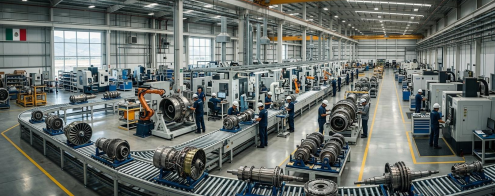
A total of 386 companies in the aerospace sector from the US, Canada, the European Union, and France established in 19 states of the country rely on national and specialized labor to carry out this high-precision industry that reaches the entire world; they generate 60,000 direct jobs and 190,000 indirect jobs. With a total of 386 aerospace sector companies distributed across 19 states of the country, generating over 60,000 direct jobs and 190,000 indirect jobs through the manufacture of high-precision parts and components, Mexico has established itself as one of the leaders in the sector, ranking as the fourth largest exporter globally, with 80% of its finished products sent exclusively to the United States, its main USMCA partner.
Specialized international and national public and private organizations highlight that major aircraft manufacturers in the world, such as Boeing from the US, Airbus from the European Union based in the Netherlands, Bombardier from Canada, Safran from France, and the US-based Honeywell, continue to bet on Mexico, boosting this industry due to its high-precision manufacturing, specialized labor, and optimal spaces for the development and assembly of components. According to the Mexican Aerospace Industry Federation (FEMIA), which represents the majority of national and foreign companies in the sector, Mexico has experienced significant growth as a supplier and exporter, after production in this industry reached 11.7 billion dollars in 2024 and 13.6 billion dollars in 2025. The same source reports that aerospace companies on Mexican soil have grown significantly, rising from 100 in 2004 to 386 in 2026. Based on data from major aircraft manufacturing companies, FEMIA reports that if this trend continues, exports could reach 22.7 billion dollars by 2029, consequently moving the country from its current fourth place worldwide as an exporter to the top two positions.
Reports from Mordor Intelligence, an India-based company specialized in industrial evaluation, indicate that the aerospace sector in Mexico operates with major global manufacturers and multinational conglomerates as both final clients and investors, driving projects such as those underway in Querétaro, Baja California, Chihuahua, Sonora, and Nuevo León. The multinational investors and clients themselves know the main products to export, such as Boeing, which purchases electrical harnesses, wing structures, turbine parts, and fuselages for its 737 and 787 Dreamliner commercial models.
Airbus exports commercial aircraft parts and doors manufactured in Mexican plants, in addition to having engineering centers and helicopters in the country, according to the metal-mechanics portal. Meanwhile, Bombardier operates a key cluster in Querétaro (an alliance of several companies) for the manufacturing of fuselages and advanced harnesses for its Global and Challenger series of executive jets. Safran, originally from France and one of the largest employers and investors in Mexico, produces key turbine parts including the LEAP engine for Airbus and Boeing, in addition to being the world's leading manufacturer of electrical harnesses in its Querétaro and Chihuahua plants.
The US-based Honeywell has an engineering research center alongside its production facilities and aerodynamic simulator testing center in Mexicali. Additionally, RTX Corporation (Pratt & Whitney / Collins Aerospace), a US multinational based in Arlington, Virginia, purchases and integrates critical engine components, sensors, and flight control systems. General Electric (GE Aerospace), based in Evendale, Ohio, designs and develops turbine technologies at its engineering center in Querétaro, one of the largest outside the United States and positioned as a key hub for this industry in Mexico.
This list also includes the US-based Gulfstream, headquartered in Savannah, Georgia, which produces aerostructure components and interior assemblies at its Baja California plant. Likewise, the metalmecanica.com platform, which has served as a link between buyers and suppliers of the industry in Latin America, highlights that exports have focused on the manufacturing of high-precision parts and components, generating 79 percent of the sector's revenue. Finished products ready for shipment to main clients include precision-machined engine and turbine components and thermal parts.
Harnesses and electrical systems such as cabling and power distribution systems also appear, along with structural subassemblies and fuselages such as wing parts, stabilizers, and main structures. Among the products in high demand are electronic, computer, and communication components installed on an aircraft.
Reports from the Ministry of Economy emphasize that 80 percent of exports leaving the country's aerospace sector companies are sent to the United States for the assembly chain of manufacturers such as Boeing, Airbus, Bombardier, Safran, and Honeywell. On this point, The Logistics World, a specialized digital content medium for the logistics industry, and FEMIA agree that 80 percent of what is produced in Mexico is sent to the US as the main client, followed by Canada with less than 3 percent, and France, Germany, and other countries with more than 5 percent.
The states with the highest concentration of plants in this industry are led by Baja California with about 97 facilities, followed by Sonora, Chihuahua, Querétaro, and Nuevo León. According to the British agency and platform IHS Markit, a leader in information, analysis, and solutions for global economic markets, there are 386 aerospace sector companies in Mexico, of which 80 percent are manufacturers, while the remaining 20 percent offer design and engineering services, as well as maintenance, repair, and overhaul (MRO).
A clear example of the growth of this industry in Mexico is its plant in Querétaro, which ranks 8th globally among cities with the best Foreign Direct Investment (FDI) results, with 72 percent for manufacturing, 13 percent for design and research, 11 percent for maintenance and repair, and 4 percent for other areas.
Author: Mario Camarillo Cortés. Source: https://www.cronica.com.mx/nacional/2026/08/06/estados-unidos-capta-80-de-manufactura-aeroespacial-hecha-en-mexico/